


Backlinks remain one of Google’s strongest signals for ranking pages. But as Google’s John Mueller noted, the search algorithm doesn’t care about the sheer number of backlinks – it cares about quality and relevance. That means a single link from a trustworthy, contextually relevant site can outweigh thousands of low-quality links. In this guide, you’ll learn nine link-building strategies used to grow a business’s organic traffic by 300 %, plus two bonus techniques to earn Google’s trust. We’ll also look at Serpzilla, a tool that automates many of the tedious tasks associated with acquiring high-value links.
Why authority matters more than link quantity
The first step in any link-building campaign is choosing who will represent your brand. You need a subject-matter expert willing to step into the spotlight and evolve from expert to authority. An expert simply has more knowledge than the general public; an authority has influence.
This distinction matters because a strong personal brand can be a huge backlink driver. For example, Gary Vaynerchuk’s personal website has over 16 000 referring domains, while his marketing agency, VaynerMedia, has more than 2 600. Building a brand around an individual not only attracts links but also establishes trust and authority.
Crucially, Google doesn’t reward the biggest link profile – it rewards the most relevant links. The company’s search advocate John Mueller explained that the total number of links pointing to a site is irrelevant; one good link from a relevant website can outweigh millions of low-quality links. Quality and relevance should be your north stars.
Create link-worthy assets with unique angles
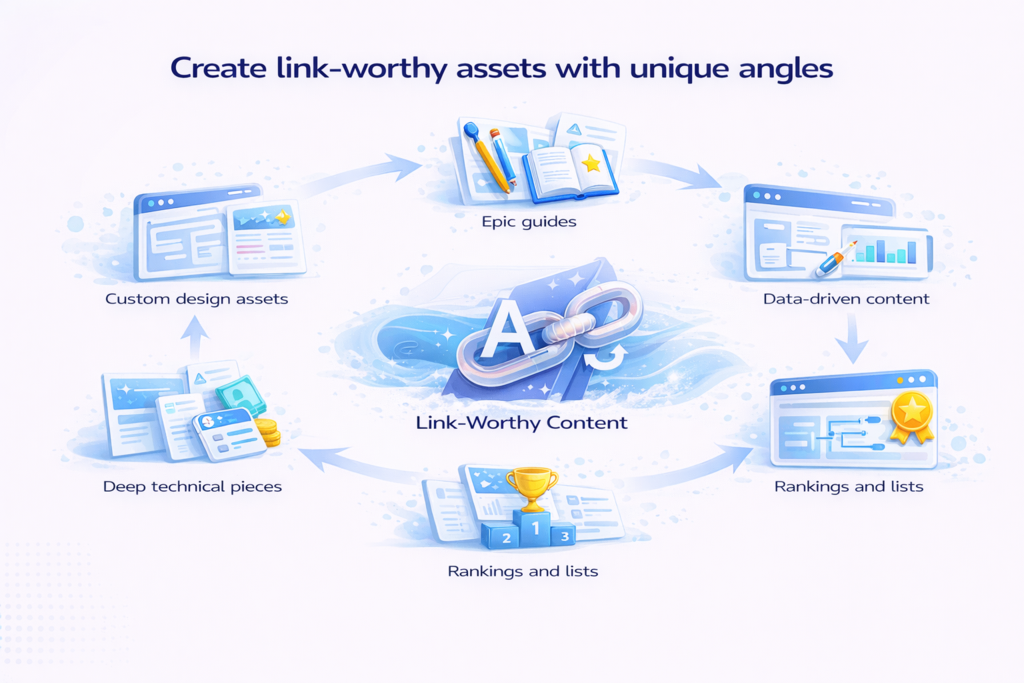
Content is the “lead domino” in link building. Without something worth linking to, outreach falls flat. The key is to find angles that work in other industries and apply them in novel ways within your own. This “Blue Ocean” approach means you’re not just replicating your competitors’ assets – you’re creating linkbait no one else in your niche has.
Here are seven proven content angles that attract links:
- Custom design assets. Investing in original design differentiates your content and makes it more shareable.
- Epic guides. Long, comprehensive guides signal authority and often earn links simply because of their depth.
- Data-driven content. Original studies, surveys or data visualisations position your brand as a primary source.
- Helpful tools or scripts. Free tools, calculators or templates are perfect for promotion and outreach. Modern AI tools can help you build them quickly.
- Weird or unusual content. Counterintuitive stories or oddities spark curiosity and conversation.
- Rankings and lists. Top-X lists and rankings draw attention and can become reference points for other writers.
- Deep technical pieces. In-depth, technical explainers serve as reference materials and generate long-term links.
Before creating an asset, verify that a similar angle hasn’t been overused in your industry. Use competitor analysis tools to see what has already attracted links, then explore other industries for inspiration. The payoff is big: unique content earns 100 % of the backlinks and all of the attention.
Prioritise relevance: the link-building pyramid
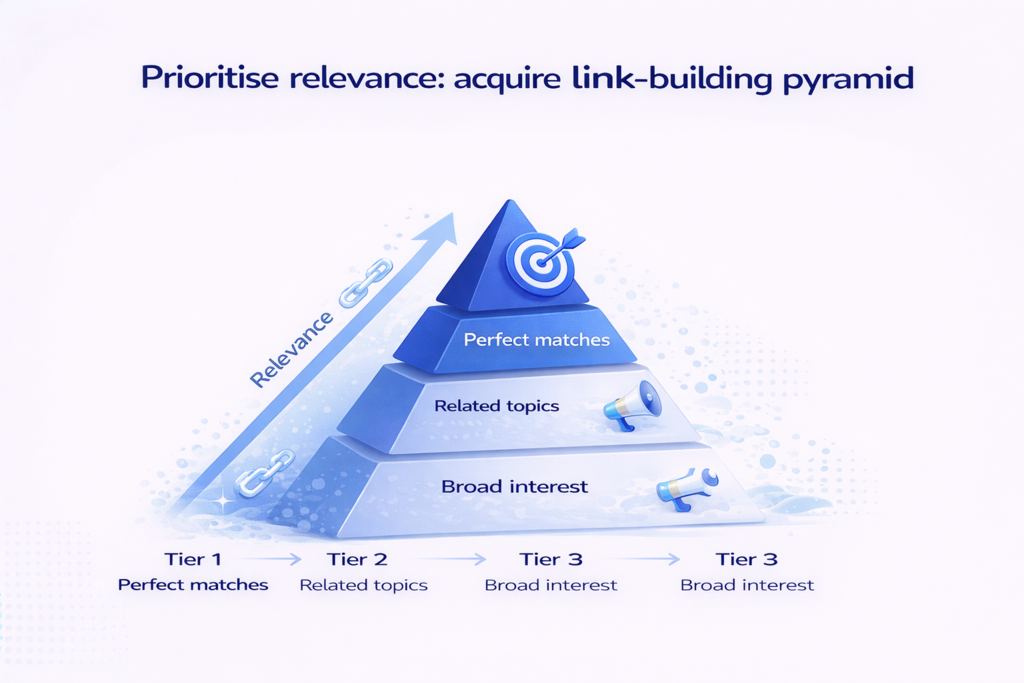
Many link builders chase metrics like Domain Authority (DA), Domain Rating (DR) or organic traffic. While these numbers matter, they’re secondary to relevance. Google’s John Mueller has said that the total number of backlinks doesn’t matter at all. What counts is relevance: a single link from a relevant site can be more impactful than millions of unrelated links.
To prioritise relevance, imagine a pyramid:
- Tier 1 – Perfect matches. These sites cover exactly the same topics and serve the same audience as you. Start here; opportunities are limited but powerful.
- Tier 2 – Related topics. These sites cover adjacent topics. For a beef jerky brand, this might include keto diet blogs or hiking sites.
- Tier 3 – Broad interest. These are broader publications where your audience might overlap (e.g., general food or lifestyle sites).
To find opportunities, use tools like Ahrefs or Semrush to see which domains rank for your core topics, then expand to related topics by looking at site search results (site:example.com) and forums like Reddit. AI tools can help you prioritise topics based on relevance. Start at the top of the pyramid and work your way down as you exhaust each level.
The merger technique: acquire and redirect authority
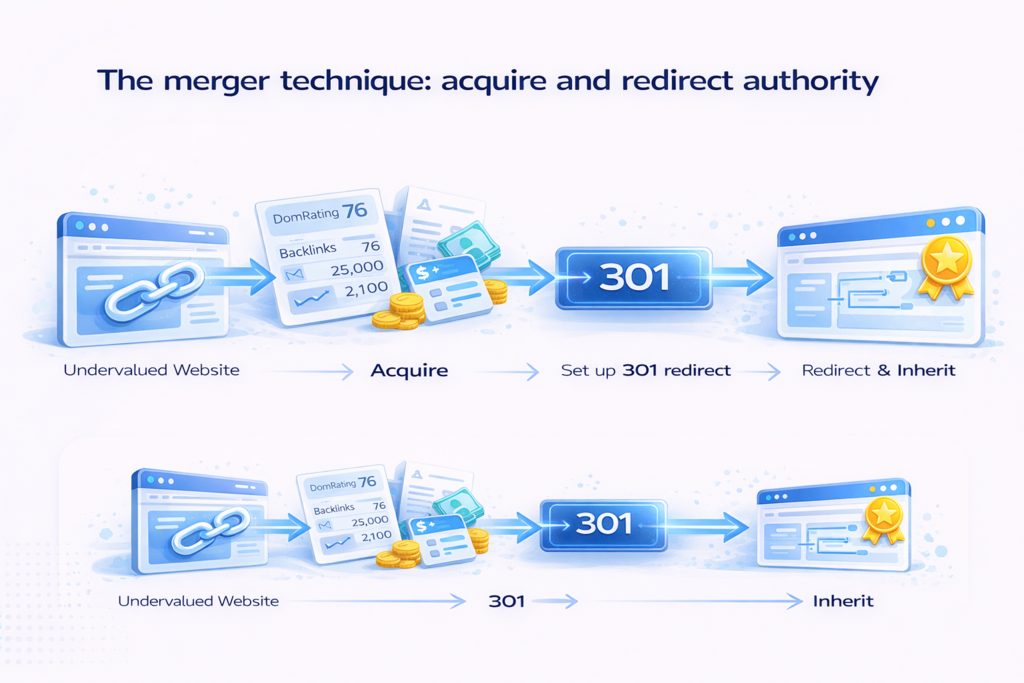
If you’re feeling like Warren Buffett, the merger technique might be for you. The idea is simple: find an existing website with a strong, relevant link profile, acquire it and then 301-redirect it to your site. When done correctly, you inherit high-quality backlinks overnight.
Follow these steps:
- Identify undervalued assets. Look for blogs or websites in your niche with high authority scores but stagnant content. Prioritise sites with editorial backlinks from relevant domains.
- Evaluate link profiles. Use tools like Semrush’s Authority Score to assess link quality. Examine anchor text distribution to avoid spammy domains.
- Estimate link value. Export the backlinks and assign a value to each based on its strength. This helps you decide how much to pay for the domain.
- Perform the redirect properly. If most backlinks hit the homepage, create a dedicated page on your site to inherit those links. If the backlinks are spread across many pages, redirect each relevant page to an equivalent page on your site. Then use internal links to distribute the link equity.
- Be patient. Opportunities are rare. Wait for the right domain and execute carefully.
Competitor link gap analysis
Sometimes the easiest links are those your competitors already have. Tools like Semrush’s Backlink Gap let you enter multiple competitor domains to see which sites link to them but not to you. Your job is to close that gap. Reach out to the sites linking to your competitors with a tailored pitch and show why your resource deserves a mention.
Similar content outreach
This strategy works when you have a unique angle on a topic. For example, if everyone writes “Best CMS for SEO” articles, your take could focus on “Best CMS for SEO in a privacy-focused world.” Identify pages covering the broader topic and reach out with a personalised email explaining your unique perspective and why it adds value to their readers.
Resource page link building
Resource pages are curated lists of helpful links. To earn a spot, you need something of exceptional value. Use search operators like "keyword" + "inurl:resources" or "keyword" + "useful links" to find opportunities. Once you’ve identified a page, craft an outreach email highlighting why your resource complements their list.
Digital PR and brand signals
Traditional link-building isn’t the only path to powerful backlinks. Digital PR – contributing expert insights to journalists and participating in interviews – can land high-authority links directly to your homepage. These “homepage links” carry enormous weight, especially if your site structure funnels link equity to deeper pages.
Beyond links, reputation matters. Google’s quality raters evaluate your brand’s reviews and social signals. The guidelines instruct raters to look for articles, reviews and forum posts about a website; negative reputation can prevent a page from earning a high quality rating. Ignoring poor reviews or failing to respond can damage trust. To build authority:
- Actively encourage satisfied customers to leave reviews on platforms like Yelp, Google Shopping or the Better Business Bureau.
- Monitor social media and review sites to address complaints promptly. Responding to negative feedback builds trust.
- Publish content that answers common concerns raised in reviews or social media posts.
Growing an engaged audience also amplifies your link-building efforts. An audience provides immediate visibility for new content, increasing the odds of earning links and mentions. Building an email list, hosting webinars and producing content on platforms like YouTube or podcasts are all effective ways to expand your reach.
Leverage existing link authority with internal links
Backlinks move the ship, but internal links steer it. Internal links are hyperlinks that connect one page on your website to another; they help users explore your content and help search engines understand how your pages relate. A strategic internal linking structure guides visitors to high-value pages and distributes SEO authority across your site.
Strong internal linking ensures that search engine crawlers can discover your pages, reinforces site hierarchy and signals which pages matter most. To leverage existing link authority:
- Use backlink analytics tools to identify pages with the strongest backlink profiles.
- From these pages, add contextual internal links to other relevant pages. This passes some of the earned authority to those pages.
- Maintain a clear hierarchy: link from high-level pages (like comprehensive guides) to deeper, more specific content.
- Regularly audit your site for orphaned pages (pages with no internal links), as they may not get crawled or indexed.
Bonus: build trust signals (reviews and audience)
The transcript’s first bonus technique emphasised reviews. Reviews act as external signals that influence a brand’s reputation and authoritativeness. Google’s quality raters consider articles, reviews and forum discussions about a business when evaluating EEAT (Experience, Expertise, Authoritativeness and Trustworthiness). A page cannot earn a high rating if raters find a convincing negative reputation. That means you must monitor and respond to reviews.
To implement this:
- Encourage reviews from satisfied customers on trusted platforms.
- Address negative feedback publicly and transparently.
- Incorporate FAQs or content that answers common questions from reviews.
The second bonus emphasised audience growth. While audience size doesn’t directly affect rankings, it indirectly increases brand authority. A loyal audience provides a ready-made distribution channel for new content, leading to more backlinks and brand mentions. Build your audience through newsletters, social media engagement and partnerships. A strong brand with authoritative signals can weather algorithm updates better than a site with only backlinks.
Finally, remember that building authoritativeness is a marathon, not a sprint. High-quality links, a strong brand and a loyal audience accumulate over time. Consistency and patience are essential.
Serpzilla – automate your link-building workflow
Manual link building is effective but time-consuming. Serpzilla is a white-hat link-building automation tool that helps SEOs find contextual, relevant and valuable links for the sites they’re promoting. It addresses several common challenges:
- Finding high-authority sites. Serpzilla’s database lets you discover websites with strong metrics and contextual relevance. It evaluates page authority, traffic sources, session length, spam score and site neighbourhood.
- Controlling costs. You can set budgets and avoid overpaying during backlink buying by comparing link prices across sites.
- Ensuring link longevity. Serpzilla monitors both rented and purchased links. Its bot crawls your links four times a day; if a link disappears or the site experiences widespread errors, the system pauses placements and notifies the webmaster. This protects your investment.
- Automating tedious tasks. The platform automates the process of finding sites, negotiating prices, placing links and monitoring them. Over 90 % of link placements are fulfilled without manual intervention, reducing labour costs and freeing you to focus on strategy.
- Evaluating sites with Serpzilla Rank (SR). Beyond using third-party metrics like DA and DR, Serpzilla has its own SR metric that analyses about 100 parameters – including content quality, user behaviour and integrations with other SEO data providers – to estimate the value of a link. Studies show that using SR can save up to 30 % of your link budget.
Serpzilla doesn’t replace the need for personal branding, unique content or PR outreach. Instead, it complements these efforts by scaling the acquisition of high-quality links and ensuring they stick. Think of it as the operational backbone of your link-building strategy.
Conclusion: build authority deliberately
The nine strategies outlined here—from building a personal brand and crafting unique content to prioritising relevance, acquiring sites, analysing competitors, creating resources, leveraging digital PR, optimising internal links and nurturing trust signals—form a comprehensive framework for modern link building. Quality and relevance trump quantity; trust and authority trump tricks.
Use tools like Serpzilla to automate the drudgery, but remember that link building is ultimately about earning real endorsements from real people. Focus on creating genuine value, building relationships and providing experiences worth talking about. With patience and persistence, you’ll build a backlink profile—and a brand reputation—that can weather any algorithm update.


